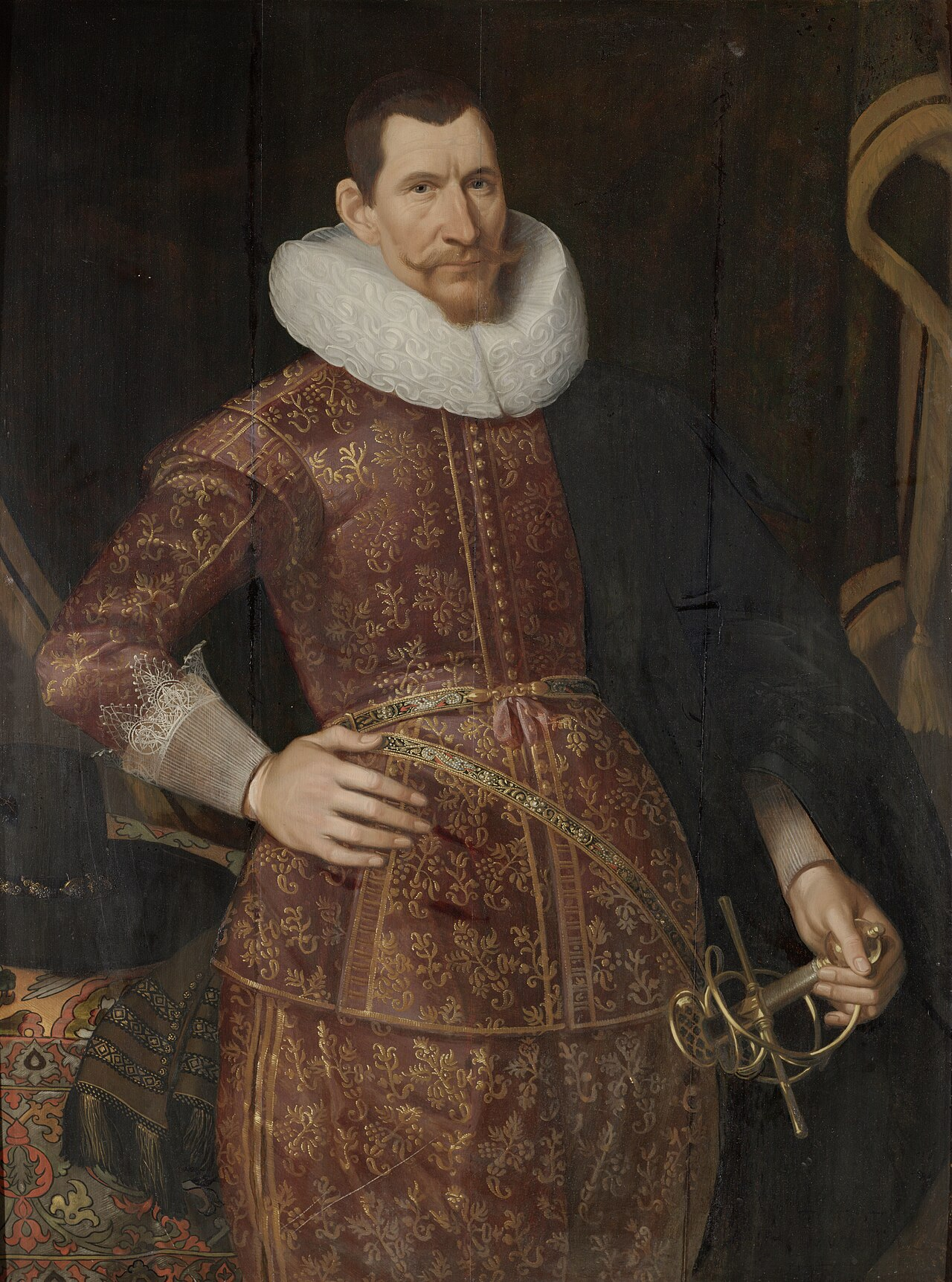
Jan Pieterszoon Coen
Governor-General of the Dutch East Indies
First Term 1619–1623 · Second Term 1627–1629
Founder of Batavia · Architect of the VOC Empire · Contested Figure of the Golden Age
Portrait attributed to Jacob Waben, c. 1620 — Rijksmuseum Amsterdam
Jan Pieterszoon Coen was one of the most influential — and most contested — figures in Dutch history. As Governor-General of the Dutch East India Company (VOC), he laid the foundations of the Dutch colonial empire in Asia during the early seventeenth century. His legacy is profoundly ambivalent: a supremely capable administrator and strategic thinker, yet also a man who wielded violence as an instrument of policy on a scale that at times unsettled even his contemporaries.
Coen grew up in the prosperous harbour town of Hoorn, studied commerce in Rome, and rose swiftly through the VOC hierarchy. His defining achievement — the city of Batavia, built upon the ruins of the conquered Jayakarta — would remain the centre of Dutch colonial administration for three centuries. His name stands for the construction of a trading empire, but equally for the brutal subjugation of the Banda Islands in 1621, in which an entire population of some 15,000 people was almost entirely destroyed.
This website examines his life and legacy from multiple perspectives: as a historical subject, as a mirror of his age, and as the focal point of a contemporary debate about how the Netherlands chooses to remember its colonial past. History only achieves depth when we are willing to confront it in full.
There can be no trade in Asia without war,— Jan Pieterszoon Coen, letter to the Heeren XVII, 1614
nor war without trade.
Biography
From merchant's son in Hoorn to the most powerful man in Asia — his life, step by step.
VOC & Context
The Golden Age, the spice trade and the world in which Coen operated.
Banda 1621
The conquest of the Banda Islands and the near-total destruction of its people.
Legacy & Debate
How is Coen remembered today? The statue controversy and the colonial inheritance.
Biography
The life of Jan Pieterszoon Coen spans just 41 years, yet his impact on Asian history reaches across centuries. From a prosperous merchant family in Hoorn, he rose to become the most powerful man in the VOC in Asia — a position he filled with exceptional organisational talent and unrelenting determination.
Hoorn — A Child of the Golden Age (1587–1607)
Jan Pieterszoon Coen was born on 8 January 1587 in Hoorn, a prosperous trading town on the Zuiderzee in North Holland. His father, Pieter Janszoon Coen, was a respected merchant; his mother Maertje Cornelisdochter Macker came from a well-known Hoorn family. The town itself was at its zenith: Hoorn was one of the six cities that had co-founded the VOC chamber, and its harbours filled with ships bound for every point of the compass.
As a teenager, Coen left for Rome, where he was apprenticed to the Italian trading house of Paschalius Nanning. This was common practice for the sons of merchant families: one learned double-entry bookkeeping in the Italian method, commercial law, and several languages. Coen was a diligent student. He mastered Italian, improved his Latin, and developed the administrative and analytical skills that would define his career.
East Bound — First Experiences (1607–1614)
In 1607, aged twenty, Coen returned to the Netherlands and entered the service of the VOC. His first voyage to the East Indies took place in 1607–1610. He sailed as a junior merchant, spent time in Bantam on the western tip of Java, and gained an intimate understanding of the complex trading and political landscape of the archipelago.
During his second voyage (1612–1618) he made a remarkable ascent through the VOC hierarchy, serving successively as accountant in Bantam, chief merchant, and director of trading posts in Bantam and Ambon. His detailed reports to the Heeren XVII — the seventeen directors of the VOC — distinguished themselves by their analytical precision and their ambitious vision of what the Company could achieve.
"Your Worships may be assured that the land of India is very rich in spices, fine gold, diamonds, silk, and many other precious commodities."
— Coen, report to the Heeren XVII, c. 1613The Discours — A Vision for an Empire (1614)
In 1614 Coen wrote his famous Discours aen d'Ed. Heeren Bewinthebberen toucherende den Nederlandtsche Indischen staet — a memorandum laying out a detailed plan for the establishment of a permanent Dutch commercial empire in Asia. This document is a key text in Dutch colonial history.
Coen's vision was at once radical and pragmatic: he argued for a central fortified trading base (a rendezvous), a system of intra-Asian trade in which the VOC itself profited on routes between Asian ports, and — crucially — the readiness to deploy military force to secure and maintain trading positions.
"Er kan in Azien geen handel gedreven worden sonder oorlog, noch oorlog sonder handel. Beyde moeten malcanderen stijven ende onderhouden."
("There can be no trade in Asia without war, nor war without trade. Each must support and sustain the other.")
"Dispereert niet, spaart uw vijanden niet, want God is met ons."
("Do not despair, spare not your enemies, for God is with us.")
The verb despereren — to despair, to lose heart — represented for Coen the greatest of failings. In his letters and commands, the exhortation recurred constantly: press on, do not waver, do not flinch. The motto encapsulated his character. It was at once a religious conviction, a military rallying cry, and a personal philosophy of life.
That this phrase gives its name to this website's domain is deliberate: dispereertniet.nl does not despair of difficult history — but neither does it seek to evade it. Coen's own words serve as a reminder that engaging honestly with his legacy demands the same resolve.
Governor-General — First Term (1619–1623)
On 27 October 1617 Coen was appointed Director-General of the VOC in Asia. On 31 May 1619 his appointment as Governor-General followed — by which point he had already founded Batavia.
In May 1619 Coen had seized and razed the city of Jayakarta — on the site of present-day Jakarta — and on its ruins erected Batavia, a rigidly planned colonial city with Dutch-style canals, bastions and a trading centre. It was to be the "Amsterdam of Asia" — and in its own way, that is what it became.
In the years that followed, Coen dispatched expeditions to the Moluccas, strengthened the VOC's position against the English East India Company, and led the conquest of the Banda Islands in 1621 — the most morally charged chapter of his career.

Eva Ment — Love in the Tropics (1621–1629)
In 1621 the sixteen-year-old Eva Ment was entrusted to Coen as his ward by her father Laurens Ment, a VOC director. Eva was sent to Batavia to marry Coen — a commercial arrangement that was not unusual in the colonial world. They wed in 1625 during Coen's stay in the Netherlands between his two terms.
Their relationship was complicated by the harshness of colonial life and by a painful scandal: before their marriage, Coen accused Eva of infidelity and had her imprisoned — a charge she firmly denied and one historians have never been able to fully resolve. The episode reveals something of Coen's character: his need for control, his fierce pride, and his tendency towards extreme measures even in his personal life. After their marriage they sailed together to Batavia for his second term. Eva outlived him and returned to the Netherlands after his death.
Second Term and Death (1627–1629)
After his first term, Coen returned to the Netherlands in 1623, enriched and celebrated. But the VOC still had need of him. In 1627 he sailed again for Batavia, now with Eva as his lawful wife.
His second term was less triumphant. Sultan Agung of Mataram besieged Batavia twice — in 1628 and 1629. The VOC city held, but the pressure was immense. Shortly after the lifting of the second siege, on 21 September 1629, Coen died suddenly of dysentery in his own city. He was 41 years old. He was buried in the Dutch Church of Batavia — his grave has not survived; the church was demolished in the nineteenth century.
Character & Methods
Coen's reports and letters reveal an exceptional analytical mind. He grasped trading flows, political relationships and logistics in ways that surpassed his contemporaries.
Where others hesitated, Coen acted. He regarded violence as a legitimate instrument for a commercial objective — not from sadism, but from cold calculation.
Coen was a Calvinist who saw his work as partly God's will. His letters are steeped in religious language — but God served his imperial project, not the other way around.
Even the Heeren XVII sometimes felt his methods went too far. His predecessor Laurens Reael had deliberately refrained from mass violence on the Banda Islands — Coen made different choices.
VOC & Historical Context
To understand Coen, one must understand the world in which he lived: an era of European expansion, globalisation avant la lettre, and a new form of commercial capitalism that for the first time in history created multinational corporations that possessed armed force.
The Netherlands in the Golden Age
The Netherlands of Coen's time was a young republic in the grip of its economic zenith. The Eighty Years' War (1568–1648) against Spain still raged, but had paradoxically intensified Dutch commercial energy: the fall of Antwerp in 1585 had driven the merchant elite northward to Amsterdam, which grew into the financial capital of the world.
Amsterdam was the hub of a global trading culture: bankers, insurers, cartographers, shipbuilders and merchants from across Europe. The invention of the stock exchange, the Wisselbank and maritime insurance made Amsterdam the first modern financial metropolis. It was in this environment that the VOC could be financed by thousands of small and large shareholders — the first joint-stock company on a global scale.
The VOC — First Multinational in the World
The Dutch East India Company (VOC), founded in 1602 through the merger of six regional pre-companies, was a revolutionary organisation. It held the right to maintain its own army and fleet — to wage war in its own name — the right to conclude treaties with foreign powers, the right to build forts and govern territories, and a monopoly on Asian trade from the Dutch Republic.
The VOC was therefore not merely a trading company — it was a quasi-state power with commercial incentives. This made figures like Coen both possible and dangerous: a man with the authority of a general and the mindset of a commercial manager, operating thousands of kilometres from his employers.
The Heeren XVII
The VOC was governed by seventeen directors, the so-called Heeren XVII (Lords Seventeen), drawn from six chambers across the Netherlands. They appointed the Governor-General and set overall policy — but with communication times of months to a year, their representatives in Asia enjoyed enormous de facto autonomy. Coen made full use of this vacuum.
The Spice Trade — The Source of Everything
Pepper, nutmeg, mace and cloves were the "black gold" of the seventeenth century. Nutmeg — produced exclusively on the Banda Islands — was so valuable that a pouch of it could buy a house in Amsterdam. Europe's demand for spices was immense: they served as preservatives, medicines and status symbols for the wealthy.
Portugal had dominated the spice trade for a century via the Cape of Good Hope. Dutch and English ventures sought to break this monopoly — and the only sustainable way to do so, Coen reasoned, was to establish their own monopolies at source. This was the logic behind Banda.
Asia Before the European Arrival
The archipelago we now call Indonesia was far from a political vacuum in the early seventeenth century. It was a world of flourishing kingdoms, sultanates and trading centres with their own political traditions and extensive trading networks reaching to China, India and the Arab world:
- The sultanate of Bantam (West Java) was a powerful trading centre attracting merchants from across the globe
- The sultanate of Mataram (Central Java) was the dominant land power on Java
- The Banda Islands had their own merchant elite — the orang kaya — trading freely with Javanese, Malays and Arabs
- Makassar was a great free port that deliberately refused to countenance any European monopoly
- The Mughal Empire and Chinese imperial states were the region's economic superpowers
Coen stepped into a world that had its own logic — and was determined to restructure that logic in the VOC's interests. That this required the destruction of existing political and social structures was for him an operational question, not a moral one.
Rivalry in Asia — The Netherlands vs. England
The VOC did not operate in a vacuum. The English East India Company (founded in 1600, two years before the VOC) was its direct competitor for the spice routes. The two companies initially attempted cooperation — the Defence Treaty of 1619 — but the partnership collapsed through mutual distrust.
Tensions culminated in 1623 in the Amboyna Massacre: VOC officials executed twenty English and Japanese merchants on the island of Ambon for an alleged conspiracy. The episode poisoned Anglo-Dutch relations for decades. Coen left Asia shortly before the executions, but his aggressively anti-English policy had created the climate in which they occurred.
Timeline
A chronological overview of the life of Jan Pieterszoon Coen and the defining moments of his era.
Born in Hoorn
Jan Pieterszoon Coen is born in Hoorn, North Holland, son of merchant Pieter Janszoon Coen. Hoorn is at this moment one of the wealthiest trading cities of the Dutch Republic.
Apprenticeship in Rome
Coen learns the trade at the Italian merchant house of Paschalius Nanning in Rome. He acquires expertise in Italian double-entry bookkeeping, commercial law and international trading practice.
Founding of the VOC
The States-General grant a charter to the Dutch East India Company — the first joint-stock company on a global scale. Coen, aged fifteen, grows up in a world being shaped by the VOC.
First Voyage to Asia
Coen sails as a junior merchant to Bantam and the Banda Islands. His first encounter with Asian trade politics and the VOC apparatus.
The Discours
Coen writes his famous Discours to the Heeren XVII — a strategic memorandum for the establishment of a Dutch commercial empire in Asia, outlining the use of military force as trade policy. His intellectual legacy.
Director-General
Appointed Director-General of the VOC in Asia — the second highest position in the organisation.
Founding of Batavia
Coen conquers and razes Jayakarta, building on the ruins the city of Batavia — a rigidly planned VOC trading metropolis with Amsterdam-style canals. Batavia becomes the capital of the Dutch East Indies and is now known as Jakarta.
Appointed Governor-General
Officially appointed Governor-General of the Dutch East Indies. Beginning of his first term.
The Banda Campaign ⚔
Coen leads a military expedition to the Banda Islands. The indigenous population of approximately 15,000 people is almost entirely destroyed: killed, displaced or enslaved. The islands are repopulated with Dutch planters and enslaved labourers. The VOC nutmeg monopoly is established.
Amboyna & Departure
Shortly before his departure, twenty English and Japanese merchants are executed on Ambon for alleged conspiracy — the "Amboyna Massacre", which poisons Anglo-Dutch relations for decades. Coen returns to the Netherlands.
Marriage to Eva Ment
Coen marries Eva Ment in the Netherlands. They will travel together to Batavia for his second term.
Siege of Batavia
Sultan Agung of Mataram besieges Batavia twice. The city holds, but hunger and disease ravage the population. Coen leads the defence.
Death in Batavia
Coen dies in Batavia of dysentery, shortly after the lifting of the second siege. He is 41 years old. He is buried in the Dutch Church of Batavia — his grave has not survived.
Map — Coen's World
An interactive map of the places and journeys that shaped the life of Jan Pieterszoon Coen: from his birthplace of Hoorn to the remote Banda Archipelago. The dashed line shows the VOC trade route via the Cape of Good Hope.
Click a marker for historical information. Scrolling and zooming enabled.
Banda 1621 — The Forgotten Genocide
This chapter describes the military campaign on the Banda Islands in 1621, during which a large part of the indigenous population was killed, forced to flee, or enslaved. It is one of the darkest episodes in Dutch colonial history — and one that Coen deliberately and systematically executed.
The Banda Islands, a small archipelago in the Banda Sea (Moluccas), were the only place on earth where nutmeg and mace grew. For the VOC they represented a monopoly of astronomical value. For the Bandanese people they were home — and would prove their near-total undoing.
The Banda Islands before 1621
The Banda archipelago consisted of ten small islands with a total population estimated at 15,000 people. The Bandanese were not a subjugated people: they were independent traders with a well-developed political system. Local leaders, the orang kaya ("wealthy people"), governed the islands and traded freely with everyone — Javanese, Malays, Arabs and Europeans.
The VOC had previously tried to establish a monopoly through treaties. The orang kaya signed but did not comply: they continued selling nutmeg to the highest bidder. From their perspective this was their unquestioned right as independent traders. From Coen's perspective it was breach of contract that justified military action. This difference in perspective cost them nearly their entire existence.
The Campaign of 1621
In March 1621 Coen sailed personally to the Banda Islands with a fleet of sixteen ships and approximately 1,600 soldiers, supplemented by Japanese mercenaries. His orders were unambiguous: subjugate the islands completely and establish the VOC monopoly.
What followed was a systematic military campaign lasting several months. The Bandanese, who had retreated into the hills, were hunted down. VOC troops and Japanese mercenaries made no distinction between combatants and civilians. Villages were burned, people killed or taken prisoner. The orang kaya who were willing to surrender were killed after attending a meeting under a pretence of safe conduct — a straightforward ambush.
"De moordenaers sullen nu haest gestraft zijn. Het is een wreed volk, dat ons alle jaren bedriegt en misleidt. Nu zijn wij hen kwijt."
("The murderers shall soon be punished. It is a cruel people, that deceives and misleads us every year. Now we are rid of them.")
The Human Cost
The Perkeniers — A Colony Built on Ash
After the campaign the Banda Islands were virtually depopulated. Coen immediately implemented the perkenstelsel. Dutch perkeniers (plantation holders) were allocated plots of nutmeg trees to cultivate using enslaved labourers — brought from other islands in the archipelago and the Asian mainland.
It was a brutally efficient economic exploitation: perkeniers were required to sell their harvest exclusively to the VOC at VOC-determined (low) prices. Those who failed to deliver risked losing their plots. The enslaved had no rights and worked in dangerous conditions with high mortality.
The system was economically successful for the VOC: the nutmeg monopoly generated enormous profits for Amsterdam shareholders for decades. But Bandanese culture, language and social structures were almost entirely destroyed.
Historical Debate — Was This Genocide?
Historians are divided over the classification of the 1621 Banda campaign. Authors such as Giles Milton (author of Nathaniel's Nutmeg) speak openly of genocide or ethnic cleansing. Others point to the absence of a written extermination order and speak of extreme colonial violence. The terminological debate does nothing to alter the facts.
The facts are not in dispute: a population of approximately 15,000 was reduced to approximately 1,000 within a matter of months. Those who were not killed fled or were enslaved. No serious historian denies the scale of the destruction.
In 2020 the Dutch government offered formal apologies for the Dutch slavery legacy. The Banda campaign forms part of this legacy — though specific recognition of it in public memory remains fragmentary.
"The Banda massacres were probably the first instance of deliberate, systematic extermination of an indigenous population in Asian history by Europeans."
— Giles Milton, Nathaniel's Nutmeg (1999)Legacy & Contemporary Debate
Four centuries after his death, Jan Pieterszoon Coen remains a contested figure. In the centre of Hoorn his statue still stands on the Roode Steen square. In the debate about Dutch colonial history, his name has become synonymous with the moral ambiguity of the Golden Age.
Organisational Legacy
Coen was an exceptional organiser. Batavia — his creation — became the hub of an Asian trading network and remained so for three centuries. His intra-Asian trading system, the so-called country trade, was financially innovative and effective. The administrative structures he established had a remarkable durability.
Economic Impact on the Netherlands
The spice trade Coen secured generated enormous wealth for the Republic. VOC dividends financed Amsterdam canal houses, paintings, scientific institutions and a flourishing civic culture. The Golden Age — as a cultural and economic phenomenon — was partly his legacy.
Architect of Colonialism
Coen's system of military force, trading coercion and administrative subjugation laid the blueprint for three centuries of Dutch colonialism in Indonesia. His methods were institutionalised and extended until decolonisation in 1945–1949. The violence he normalised reverberated across an entire colonial era.
The Banda Massacres
The near-total destruction of the Bandanese population in 1621 is the most concrete charge against Coen. He personally ordered a campaign in which approximately 93% of an indigenous population was killed, displaced or enslaved. This is not abstract historical debate — it is a documented fact.
The Statue in Hoorn — A National Debate
In the centre of Hoorn a statue of Jan Pieterszoon Coen has stood for over a century, erected in 1893 on the Roode Steen square as a tribute to a great son of Hoorn — a hero of Dutch expansion in an era that saw itself as a bearer of civilisation.
Following the murder of George Floyd in 2020 and international debates about statues of colonial figures, the Hoorn statue became the subject of heated public debate. Petitions were filed, council meetings held, and local and national media weighed in.
The Hoorn town council decided not to remove the statue, but instead to place a contextual information board describing his role in the Banda massacres. This compromise satisfied neither camp: those in favour of removal saw it as insufficient; opponents saw any explanatory board as an attack on historical heritage. The debate mirrors a broader Dutch difficulty in confronting its colonial past.
Coen as a Mirror of the Dutch Soul
The debate about Coen is ultimately a debate about how the Netherlands wishes to remember its Golden Age. The wealth of that period — visible in Amsterdam's canal houses, the Rijksmuseum collection and the Dutch Masters — was made possible in part by the trade that men like Coen established through force.
It is insufficient to say that Coen was "a man of his time": his own contemporaries knew that his methods were extreme. His predecessor Laurens Reael had deliberately refrained from subjugating the Banda Islands by mass violence. Coen made different choices — and those choices had consequences that echoed through generations.
Yet historical simplification is equally a trap. Coen was not a lone psychopath: he was a rational actor within a system that rewarded violence and that was built by thousands of shareholders, trading houses and directors who reaped the fruits of his methods. The responsibility is shared — but Coen bore it more heavily than most.
How to Place Coen in Perspective
A nuanced view of Coen requires holding multiple truths simultaneously:
- He was an exceptionally gifted organiser and strategist — this is a historical fact, not a defence.
- VOC methods were the product of a system, not solely of one individual — but Coen was the architect of its most extreme application.
- The Banda massacres are a genocide-like episode that cannot be written off as "of its time" — his own contemporaries were sometimes appalled.
- His legacy lives on in modern Jakarta, in Indonesian economic geography, and in the Dutch reckoning with its colonial past.
- To remember him as a hero is morally untenable; to erase him from history entirely is historically dishonest. Recognition — including of the darkness — is the only path of integrity.
Sources & Further Reading
Primary Sources
- Coen's letters to the Heeren XVII (National Archives, The Hague — VOC archive)
- Discours aen d'Ed. Heeren Bewinthebberen toucherende den Nederlandtsche Indischen staet (1614)
- Batavia Day Registers, 1619–1629
Academic Literature
- Femme Gaastra, Geschiedenis van de VOC (2002)
- H.T. Colenbrander, Jan Pietersz. Coen: Levensbeschrijving (1934)
- Els Jacobs, Koopman in Azië (2000)
- Giles Milton, Nathaniel's Nutmeg (1999)
- Willard Hanna, Indonesian Banda (1978)
Contemporary Debate
- Dutch Government Report on the Slavery Legacy (2022)
- NRC Handelsblad — articles on the statue debate (2020–2023)
- National Archives: VOC collection (searchable online at nationaalarchief.nl)